We open the doors to the most mysterious and most questioned part of the Ottoman Empire—the Harem. In this journey filled with historical facts, strong female figures, social and cultural influences, and legends that have traveled from tongue to tongue for centuries, you will discover that the Harem was not just a living space but a center of power.
While browsing through the dusty pages of history, the most mysterious, most curious, and perhaps the most imagined place associated with the Ottoman Empire is undoubtedly the Harem. Walking through those splendid yet quiet corridors of Topkapi Palace, it is impossible not to feel what has happened behind the walls for centuries. Although Western painters often depicted it as an exotic pleasure garden on their canvases, in truth the Harem was a center of a strict discipline, the delicate strategies of state governance, and incredible female power. Today, looking back from the window of 2026, we can see more clearly that the Harem was not only the sultan’s house but also the stage for women who determined the empire’s fate. In this article, we will embark on a journey toward the real world behind those heavy doors, the rise of women, and the legends that have circulated from generation to generation.
What is the Harem? The Gap Between Facts and Perceptions
The word Harem carries meanings such as 'forbidden', 'protected', and 'sacred', and it actually represents the most intimate part of Ottoman social structure. For centuries, the Western world’s orientalist view framed it as 'only a place of pleasure and entertainment'. However, historical documents and research reveal a much more complex reality. It's important to acknowledge that this 'Orientalist' view, while pervasive, doesn't represent the full picture. The Harem was not only a home where the sultan maintained his private life, but also a very disciplined school where enslaved women received top-level education, learned etiquette, music, literature, and religious knowledge. Entering the Harem, young girls were evaluated not only by their beauty but also by their intellect and talents, and they underwent a challenging education to rise within palace hierarchy.
The life in the Harem was not a matter of luxurious idleness seen from outside; rather, every minute was planned, rules were strict, and a sharp hierarchy prevailed. The day began in the early hours with prayers, lessons, and service duties. The aim of this order was to raise capable individuals worthy of the sultan and the dynasty. Therefore, to understand the Harem one should not view it merely as a 'convent of women' but as one of the era’s most prestigious educational institutions. Women raised within these walls would later leave their mark on the empire’s social life as the wives of grand viziers, Valide Sultans, and benevolent foundation founders.
The Power Hierarchy in the Harem: From Concubine to Valide Sultan
Outwardly, the Harem appears as a homogeneous group of women, yet internally there was a very strict and difficult-to-ascend rank system. From the moment a concubine set foot in the palace, reaching the top position of 'Valide Sultan' required not only great luck but also exceptional intelligence. This hierarchical structure was the cornerstone of order and discipline in the palace. Everyone had to know their place, their duties, and to whom they were responsible.
To better understand these complex power steps in the Harem, the basic ranks can be summarized as follows:
| Rank | Description and Duties | Power Level |
| Novice Concubine | New to the palace, candidates in the training process. | Lowest |
| Concubine / Kalfa | Those who have completed training and are in service or in a master-teacher position. Başkafa kaldırıldı, Kalfa daha yaygın bir terim. | Medium |
| Favor (İkbal) | Concubines who catch the sultan’s eye and are liked. | High |
| Haseki Sultan | Wives who bore the sultan his male children. They had private apartments and attendants. | Very High |
| Valide Sultan | The mother of the reigning sultan. Absolute ruler and administrator of the Harem. | The Peak |
The Authority of the Valide Sultan
At the very top of this pyramid sits the Valide Sultan, the indisputable ruler of the Harem. When her son ascended the throne, she moved with great ceremony from the Old Palace to Topkapi. She not only governed the Harem but also advised her son in state affairs. All appointments, punishments, rewards, and marriages within the Harem required her approval. The Valide Sultan’s chambers were located at the most magnificent and strategic point of the Harem, symbolizing her control over both the Harem and the sultan. Figures like Kösem Sultan or Nurbanu Sultan are among the most striking examples of the power this position could extend beyond the empire’s borders.
Women’s Sultanship: The Empire Behind the Curtain
The period spanning the 16th and 17th centuries in Ottoman history is referred to by historians as the 'Regency of Women' or 'Women’s Sultanship'. This era marks the moment when the Harem ceased to be merely a living space and transformed into an active political power center. Beginning with Hürrem Sultan, the sultan’s legal wife, this era signals a peak in the influence of women in governance. When the sultans went on campaigns or when governance faced a vacancy, the strong women of the Harem stepped in, writing diplomatic letters and making decisions for the empire’s survival.
Hürrem Sultan, Nurbanu Sultan, Safiye Sultan, and Kösem Sultan were among the most powerful names of this period. Especially Kösem Sultan, who personally governed the state on behalf of her sons and grandson, sought to keep the ship on its course during the empire’s most turbulent times as Naib-i Saltanat (Deputy of the Sultanship). These women won the people’s hearts not only through palace intrigues but also through their charitable foundations, mosques, bathhouses, libraries, and kitchens. The skyline of Istanbul bears witness to their architectural and economic power in the form of the Yeni Cami and the Atik Valide Mosque in Üsküdar. These structures not only served religious and social needs but also contributed to local economic vitality by creating employment. Through endowments, food was provided to the poor, scholarships were given to students, and free medical services were offered to the sick. This shows that the women of the Harem acted not only with palace power but also with a sense of social responsibility.
Legends and Mysterious Tales of the Harem
Like everything hidden behind closed doors, the Harem has been the subject of countless legends for centuries. Tales whispered among the people and exaggerated by travelers have veiled the truth in a mystic veil. Yet many of these legends draw from the depths of palace rivalry and human psychology. The isolated life in the Harem is the greatest fuel for the imagination.
Some of the most well-known and intriguing legends about the Harem include:
- The Legend of the Golden Path: The stone-paved road connecting the section where the concubines resided to the sultan’s chambers is called the 'Golden Path.' It is said that during festivals the sultan would shower the concubines with gold as he passed along this road. For the concubines, this road symbolized both hope and a symbolic route to reach the sultan. Some legends claim that the sultan’s frequency of using this path was proportional to the number of concubines, creating a sweet rivalry among them.
- Secret Tunnels and Passages: There is a very common legend of hidden tunnels under the palace that lead to the outside or to the sultan’s chambers. Some stories say that concubines who fell from favor or were punished were thrown into the sea through these tunnels, though such tales are often dramatic fabrications. Although there is no conclusive evidence for the tunnels’ existence, the palace’s complex structure and the architecture that allows secret passages have kept this legend alive.
- Pearl and Spell Tales: There are countless stories of women in the Harem resorting to talismans, charms, and the energy of precious stones to neutralize rivals or win the sultan’s favor. Some seals in the palace archives show how widespread such beliefs were at the time. There are various legends about stones like agate, emerald, and ruby used with different intentions.
- Bloody Rivalries: In particular, the fierce competition among the mothers of princes to place their son on the throne is the source of some of the most tense legends witnessed by Harem walls. Poisonous punch or poisons smeared on embroidered robes are central to these dark tales. One of the most famous examples of this rivalry is Hürrem Sultan’s struggle with the other princes’ mothers.
An Architectural Labyrinth: The Living Spaces in the Harem
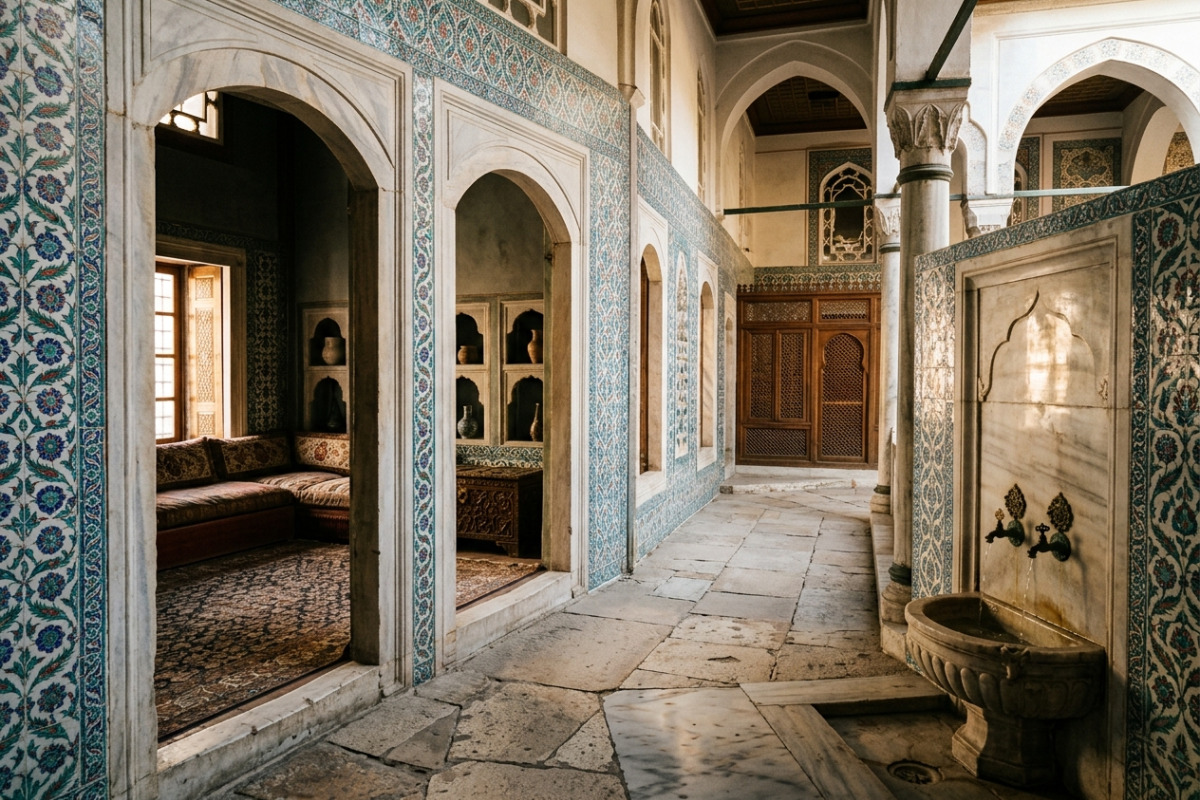
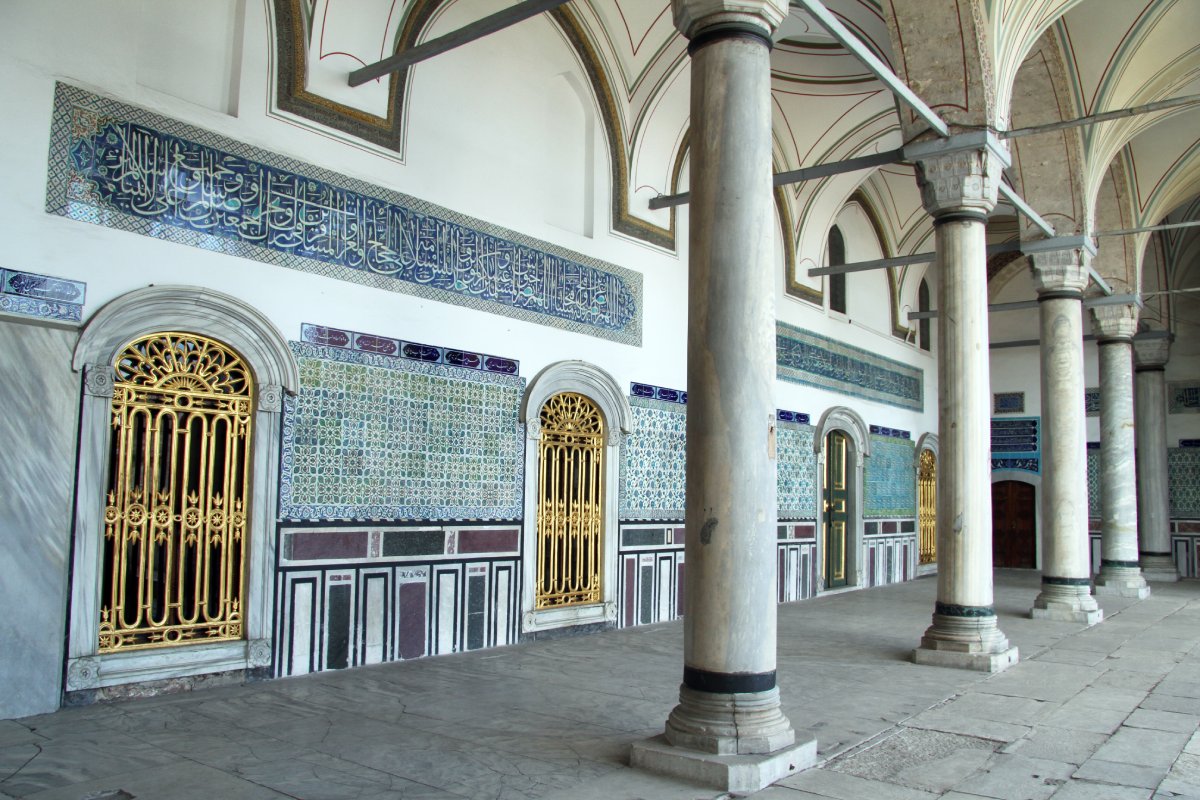
When you visit the Topkapi Palace Harem, the maze-like feel created by narrow corridors, interwoven rooms, and sudden courtyards immediately captivates you. Architecturally, the Harem is designed to protect privacy. Windows are usually high and gridded; this prevents the outside world from looking in while limiting those inside from engaging with the outside world. Yet this enclosure does not overshadow the interior elegance. Iznik tiles, the most exquisite examples; mother-of-pearl-inlaid cabinets; gilded ceilings; and marble fountains reveal the Harem’s aesthetic richness.
Palatial halls such as the Hünkâr Sofası were social spaces where the Harem’s residents gathered, celebrations were organized, and greetings of the day took place. (Subtext: The Hünkâr Sofası was one of the most magnificent spaces in the Harem.) In contrast, areas like the Valide Sultan’s chamber or the Gözde sisters’ chambers reflected more personalized luxury. (Subtext: The Valide Sultan’s Chamber was considered the heart of the Harem.) Baths were an indispensable part of Harem life; not only for cleansing but also as the best places to socialize and exchange gossip. (Subtext: The Harem Bath was a social space as well as a cleaning area.) Harem architecture, in fact, is a language that imprints the internal hierarchy on stone and wood; the size and decoration of a space are proportional to the power of the person living there.
Conclusion: The Silent Witnesses of History
The Ottoman Harem is neither a pleasure garden as imagined by orientalists nor a mere dark prison. It is a multi-layered world located at the heart of the empire, where women fought to exist through their intelligence and will, guided the state’s fate, and where education and discipline intertwined. As you wander those empty rooms today and touch the coolness of the porcelain, you can feel Hürrem’s laughter, Kösem’s anxious whispers, or the homesickness of an unnamed concubine. The Harem continues to preserve its mystery as an eternal monument to the power, resilience, and legendary lives of Ottoman women.